
Trustline security assessment, June 2026: 40 findings on an EVM sanctions-screening SDK
Trustline engaged Fidesium to assess the EVMSDK and the validation-engine-sanctions-only program: the Solidity contracts an integrator inherits from (Trustlined) and the upgradeable TrustlineSanctionsOnlyVE proxy that routes every guarded call through a sanctions oracle. The engagement ran from May 25 to June 1, 2026, with a follow-up pass that closed on June 26, 2026.
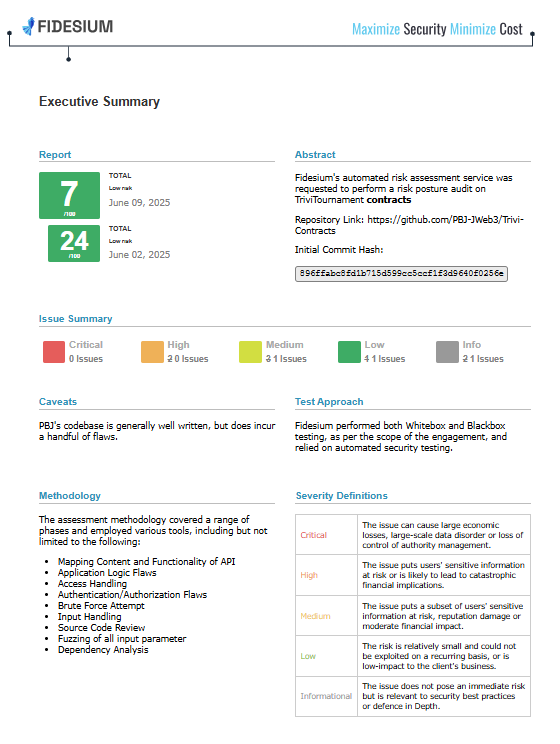
The first report flagged 40 issues: 1 critical, 6 high, 16 medium, 5 low, and 12 informational, putting the codebase at a 48/100 medium-risk score. After the fix pass, 25 of those were closed. The remaining 15 are either scoped to the integrator’s own code or accepted as design trade-offs, and the codebase now sits at 23/100, low risk.
What was reviewed
| Protocol | Adrena, perpetual futures |
| Chain | Solana |
| Engaged by | Autonom |
| Repository | github.com/TrustLine-id/evmsdk github.com/TrustLine-id/validation-engine-sanctions-only |
| Audited commit, initial | 967387946156c99b3ae344e23393dfda2077d9af 127f10357b57fe574b0f52c74b61ac5fee66757a |
| Audited commit, review | 9f180bf8e914fe5831ca3047c310837234f652c0 51d99518adea872c12670c39f7df9bcb12ecaa74 |
| Source files | 5 |
| Source lines of code | 315 / 194 core |
| External Entry Points | 22 (proxy) + 1 (Trustlined) |
| State Variables | 7 declared, 2 live |
| Assessment period 05 May to 26 June 2026 | Review period 01 June 2026 | Delivered 26 June 2026 | Report version 1.2 |
In scope: 5 source files, around 315 lines total (about 194 lines of code), 22 external entry points on the proxy plus one on Trustlined, and 7 declared state variables (2 of them live in the sanctions-only flow). Out of scope but flagged in appendices: the frontend bundle, PaymentFirewall, and the TrustlinedUpgradeable initializer.
The audit assures the mechanism around the sanctions oracle. It does not, and cannot, establish that an integrator built on Trustline is regulatory compliant: a boolean address-membership oracle cannot express OFAC’s 50% rule, identity resolution, jurisdiction selection, or designation freshness. That gap is tracked as finding I8.
The findings
The 28 critical/high/medium issues collapse into six root causes:
Critial
0
High
1
Medium
5
Low
1
Info
8
A full pass with Slither and the Fidesium analyzer corroborated the manual findings, and 88 Foundry PoCs exercised each exploit path end to end.
- Unbounded admin and upgrade authority. A single
DEFAULT_ADMIN_ROLEon the proxy could renounce itself, swap the oracle, upgrade the logic, or disable screening, with no event, no timelock, and no last-admin floor. Covers C1, H6, M1, M2, I12, M16. - Weak engine binding.
Trustlinedvalidated a passed proxy/logic withcode.length > 0and encoded the initializer selector from a string, so an integrator could bind to any contract. Covers H1, H2, H4, M13, M14. - The oracle was an unconstrained dependency.
sanctionsOracle.isSanctioned(...)was called in a loop with notry/catch, no gas budget, no conformance check at set time, and no freshness or staleness guard. Covers H3, M4, M7, M8, M10. - Incomplete screening scope. The SDK shipped with the gate disabled, screened only
msg.senderplus a caller-suppliedaddresses[], discarded the return value ofcheckTrustlineStatus, and did not re-screen at settlement. Covers H5, M3, M5, M6, M9. - The operator surveils users. Full
msg.datawas forwarded to the VE on every guarded call, so under a shared-proxy model a single operator could harvest every integrator’s complete calldata. Covers M12, M15. - Shipped artifact did not match audited source. No pinned toolchain, no lockfile, no npm provenance, and the published build lived outside the audited repo. Covers M11.
What was fixed, and how it was verified
An unconstrained admin key could brick the engine in a single transaction
Pinned, the DEFAULT_ADMIN_ROLE holder on a VE proxy could do any of three terminal things with no on-chain record: renounce admin and permanently freeze the engine in whatever state it was in (including fail-open), swap sanctionsOracle to a lying or dead contract, or upgrade _authorizeUpgrade straight through to attacker-controlled logic. Because every integrator bound to that proxy routes requireTrustline through it, a single signature could defeat screening across the entire integrator base.
The fix moves DEFAULT_ADMIN_ROLE behind a multisig and timelock, adds a last-admin floor that prevents the final renounce, introduces upgrade-target validation on _authorizeUpgrade, and emits events on every configuration change (closing M2 at the same time). C1, H6, M1, M2, I12, and M16 all reduced or cleared in the follow-up review.
A reverting sanctions oracle could brick every integrator entry point
SanctionsOnlyValidationEngine._isSanctionsApproved iterated over the screened set and called isSanctioned without a try/catch and without a gas budget. An oracle that reverted, returned junk, or burned the forwarded gas would take down every requireTrustline call on every integrator at once, converting an availability failure at the oracle into a hard denial-of-service across the SDK.
The fix bounds the oracle call with a gas budget, wraps it in try/catch with a typed fail-closed result, and adds a conformance check at setValidationConfiguration time so a non-conforming oracle cannot be installed in the first place. H3, M4, M7, M8, and M10 are closed or materially reduced.
An attacker could race Trustline to initialize an uninitialized proxy
If a TrustlineSanctionsOnlyVE proxy was ever deployed with empty init data (the “adopt” path, or any scripted two-step deploy), the first caller to land initialize(address) became the proxy’s admin. On a congested chain or against a pending mempool transaction, this was a race Trustline could lose, and the winner would silently own every integrator that later bound to that proxy.
The fix forces atomic initialization on the deploy-fresh path, emits ValidationEngineDeployed on the adopt path (closing I10), and locks the logic contract so it cannot be initialized directly. H1, H2, H4, L4, and I10 are closed; H1’s string-encoded selector was replaced with a typed initialize.selector.
The remaining fixes
The other twenty closures track the same six root causes. M11’s supply-chain gap is closed by a committed lockfile, a pinned toolchain, npm provenance, and an on-chain bytecode-verification step against the audited tuple. M13 (EIP-7702-delegated EOAs defeating engine binding) is closed by rejecting 7702-delegated code at bind time. L2’s floating pragma is pinned to solc 0.8.34. L3’s disable-path no longer blanks sanctionsOracle to address(0). I4’s empty _authorizeUpgrade is now a validating guard.
Fifteen findings remain open after the follow-up. The highest-severity open item is H6: IValidationEngine.requireTrustline is still declared non-view, so integrators emit CALL rather than STATICCALL at the compliance gate and cannot rely on the gate being state-neutral. Trustline acknowledged H6 and the remaining medium-tier items (M5, M6, M8, M9, M10, M12, M14, M15, M16) as integrator-surface obligations: each one lives in the contract an integrator writes, not in the SDK itself, and the report’s integrator-surface appendix spells out the per-function self-audit method a team needs to clear them.
How the assessment was run
Lead reviewer: Abraham Polishchuk (@skilurus).
The method was integrator-centric. Because the in-scope contracts are non-custodial, every severity score was computed against the party that actually bears the impact, which is almost always the integrator or the integrator’s end users, not Trustline. That is why findings like H5 (fail-open default) and M3 (clean-intermediary bypass) are scored high and medium rather than informational: they are design defaults an integrator inherits by accident.
Techniques used, in rough order of weight:
- Manual source-code review of all five in-scope files, including storage-layout and selector-collision inspection across the proxy surface.
- Threat modelling by actor: malicious admin, malicious oracle, malicious integrator developer, bypass-seeking end user, and supply-chain attacker. Each role has its own attack table in the report and composes into five named attack chains (G.1 through G.5).
- Protocol-interaction and composition analysis: EIP-7702 delegation, Diamond/delegatecall slot-0 collisions, account-abstraction composition, and cross-chain deploy determinism.
- Static analysis with Slither and the Fidesium analyzer against both repositories.
- 88 Foundry proof-of-concept tests covering every critical, high, and medium finding.
- Cross-configuration differential testing: the audited
solc 0.8.34 / osakaconfiguration, thecancunconfiguration, and the shipped-SDK0.8.28 / cancunconfiguration. Gas costs for every gas-grief finding were byte-identical across all three. - Distribution and supply-chain review: npm artifact versus audited source, lockfile presence, provenance, and on-chain bytecode comparison.
- Differential review against upstream HEAD on both repositories, so every fix was verified against the exact commit that shipped it.
The signed report
The full signed report (Trustline-V1.2-26-06-2026.pdf) is the authoritative record of this engagement. It contains the per-finding writeups, the recommendation text that landed in each fix, the governance and trust-model section, the attack-chain appendix, the differential-review tables commit by commit, and the integrator-surface self-audit method referenced above.
Request a quote
An audit of this depth starts with scope, and scope starts with a conversation about which parts of the codebase carry the risk. Fidesium’s manual smart contract audits are line-by-line reviews by the engineers who built the tooling, with two rounds of fix verification included, priced from $5,000 depending on the codebase.
Tell us what you are shipping and when, and we will scope it.