
Sumvin risk audit on Sei, February 2026: 9 findings, none Critical
Fidesium ran a risk audit of Sumvin’s contracts, and the signed report is dated 10 February 2026. Sumvin is a soulbound ERC-721 identity protocol on Sei, written in Solidity for the EVM. The report raised 9 findings: 1 High, 2 Medium, 2 Low and 4 Informational, with no Critical. It scored the contracts 11 out of 100, in the low-risk band. Every finding carries the status Active, and the report records no remediation review.
What was reviewed
| Protocol | Sumvin, a soulbound ERC-721 identity token |
| Chain | Sei (EVM) |
| Contracts | Solidity |
| Source Supplied | A zip file. The report gives no public repository and no contract link |
| Audit Commit | None given in the report |
| Size | About 290 lines of Solidity, per the case study. The report gives no line count |
| Report date 10 February 2026 | Test approach Whitebox and blackbox, with automated security testing | Findings 9 |
The report describes the work as a risk posture audit of Sumvin’s contracts. The team handed the code over as a zip file rather than through a repository, so there is no commit hash to anchor the scope, and the signed report is itself the record of what was reviewed.
The report’s own summary of the code is one line: generally well written, with a handful of flaws.
The findings
Nine findings were raised in total.
Critical
0
High
1
Medium
2
Low
2
Info
4
The findings
The report raised nine findings, and its Issue Summary and its Risk Issues table agree on the split.
| Severity | Findings | Probability, as rated | Status in the report |
|---|---|---|---|
| Critical | 0 | ||
| High | 1 | Info | Active |
| Medium | 2 | Low for both | Active |
| Low | 2 | Low for both | Active |
| Informational | 4 | Certain for one, Info for three | Active |
Active is the report’s term for a finding that was open when the report was issued. All nine are recorded that way, and none of the nine write-ups records a fix. This page therefore gives counts, ratings and statuses only. The name, location and recommendation for each finding are in the signed report, linked below.
On Critical the report is explicit. No critical vulnerability was identified, and the assessment covered the smart contract logic, the access controls and potential attack vectors.
What was fixed, and how it was verified
How the report grades severity
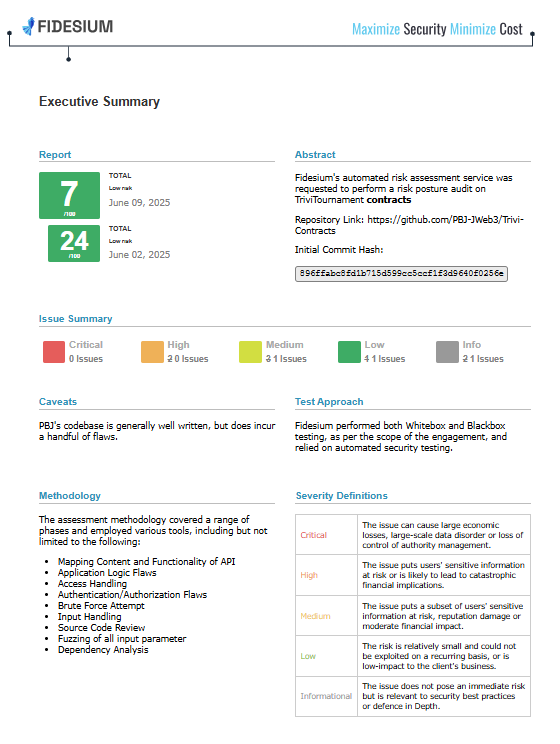
Each finding carries two ratings: a severity for its impact and a probability for how likely it is to occur. The severity scale is defined in the report as follows.
| Severity | What it means in this report |
|---|---|
| Critical | Can cause large economic losses, large-scale data disorder, or loss of control over authority management |
| High | Puts users’ sensitive information at risk, or is likely to lead to catastrophic financial consequences |
| Medium | Puts a subset of users’ sensitive information at risk, or causes reputational damage or moderate financial impact |
| Low | Relatively small, cannot be exploited on a recurring basis, or has low impact on the client’s business |
| Informational | No immediate risk, but relevant to security best practice or defence in depth |
How the assessment was run
The report lists nine methods, and states that the work was not limited to them:
- Source code review
- Application logic flaw analysis
- Access handling
- Authentication and authorisation flaw analysis
- Input handling
- Fuzzing of every input parameter
- Brute force attempts
- Mapping of API content and functionality
- Dependency analysis
Testing was both whitebox and blackbox, as scoped, with automated security testing.
The review framework behind this engagement, and what makes an identity contract a different audit target, are written up in the case study Fidesium x Sumvin: auditing a soulbound identity protocol on Sei. This page sets out what the signed report records.
Request a quote
Governance, proxies and factories are where Solidity protocols carry their deployment-day risk, and those are the parts a scoped review reads first. Fidesium’s manual smart contract audits and security services are run by the engineers who built the tooling, with two rounds of fix verification included and pricing from $5,000 depending on the codebase.
Tell us what you are shipping and when, and we will scope it.