
Fore Protocol risk audit on Arbitrum, March 2025: 34 findings, all nine High resolved
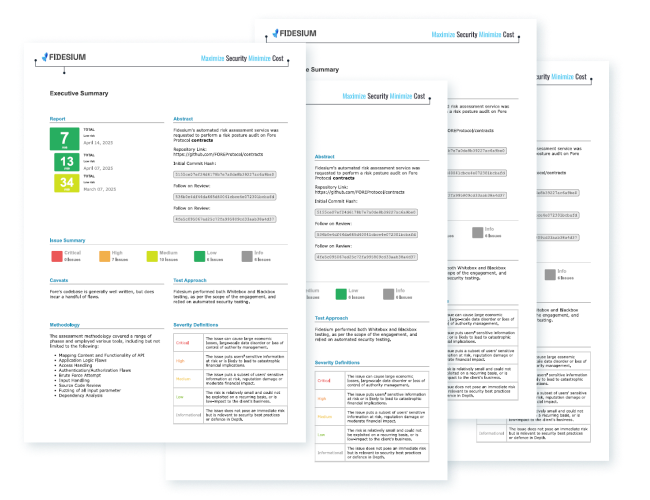
Fidesium ran a risk audit of Fore Protocol’s Solidity contracts, and the report is dated 7 March 2025. It raised 34 findings: 9 High, 11 Medium, 7 Low and 7 Informational, with no Critical. All nine High findings are recorded as resolved, along with eleven findings of lower severity. Two follow-on reviews took place in April 2025, and the risk score fell from 34 out of 100 at the first report to 7 out of 100 on 14 April 2025.
What was reviewed
| Protocol | Fore Protocol |
| Chain | Arbitrum |
| Contracts | Solidity |
| Repository | github.com/FOREProtocol/contracts |
| Audited commit, initial | 5155ce07ef24d6178b7e7a0de8b39227ac6a9be0 |
| Audited commit, review | `536b0e4df44da665d40041cbce4e072301bcbafd` and `4fe5c095067ed25c72fa995809cd33aab38a4d37` |
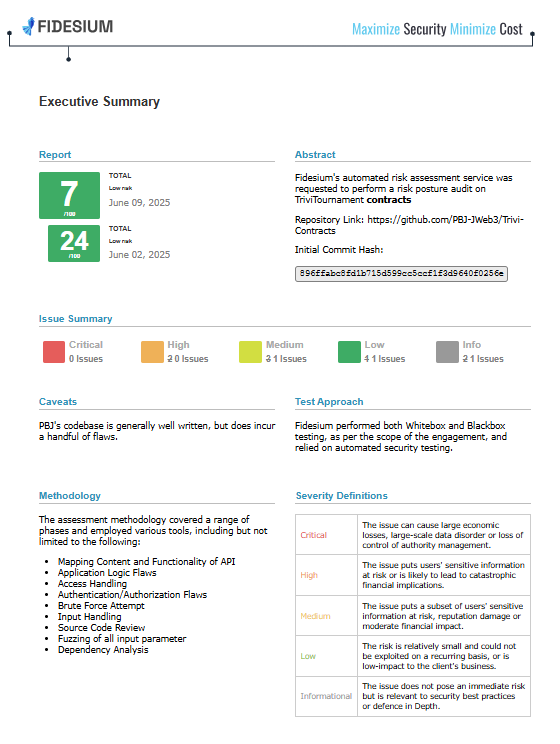
| Report date 7 March 2025 | Risk score 34 out of 100 on 7 March 2025, 13 on 7 April 2025 and 7 on 14 April 2025, each rated low risk | Test approach Whitebox and blackbox, with automated security testing | Findings 34 |
The report describes the engagement as a risk posture audit of the Fore Protocol contracts. The findings landed in three areas: the governance contracts and their timelock, the factory that deploys markets, and the router and incentive registry that handle tokens.
The report also carries a team risk section. It records no issues found in the founding team, a public doxxing status, and team experience rated as highly relevant.
The findings
Thirty-four findings were raised in total.
Critial
0
High
9
Medium
11
Low
7
Info
7
All nine High findings are recorded as resolved. One finding first rated High was downgraded to Medium in the report, and it is resolved too. Fourteen findings remain open or only partly remediated in the signed report: 7 Medium, 3 Low and 4 Informational. None of them is High or Critical.
Findings whose fixes are recorded in the report:
| Finding | Severity | Status | Fix commit |
|---|---|---|---|
| Reentrancy in the timelock’s transaction execution | High | Resolved | 86c5de05 |
| Governance votes counted with no holding or staking requirement, open to flash loans | High | Resolved | 86c5de05 |
| Front running on predictable Create2 market addresses | High | Resolved | 536b0e4d |
| Router token address not checked as a contract or an ERC20 | High | Resolved | 86c5de05 |
| Incentive registry tokens not fully validated | High | Resolved | 86c5de05 |
| Transaction queueing open to any caller when no moderator was set | High | Resolved | 86c5de05 |
| Governor proxy without storage collision protection | High | Resolved | 86c5de05 |
| Proxy implementation set before the admin | High | Resolved | 86c5de05 |
| Function selector taken from an unchecked signature string in the timelock | High | Resolved | 86c5de05 |
| Governance token not validated, with raw ERC20 transfer calls (first rated High) | Medium | Resolved | 86c5de05 |
| Timelock address in the governor not checked as a contract | Medium | Resolved | 86c5de05 |
| Protocol and Permit2 addresses in the router not checked as contracts | Medium | Resolved | 86c5de05 |
| Unchecked external calls in the market contract | Medium | Resolved | 86c5de05 |
| Governor transfers made without a balance check | Low | Resolved | 86c5de05 |
| Governor transfers made without an allowance check | Low | Resolved | 86c5de05 |
| No check for circular or redundant proposals | Low | Remediated | 86c5de05 |
| Zero value transfers allowed in the governor | Low | Resolved | 4fe5c095 |
| Gas optimisation: repeated storage reads | Informational | Resolved | 4fe5c095 |
| Gas optimisation: uint256 used where a smaller type would do | Informational | Resolved | 4fe5c095 |
| Gas optimisation: whole market struct copied when only some fields were read | Informational | Resolved | 4fe5c095 |
What was fixed, and how it was verified
Governance votes could be borrowed for the length of one transaction
The governor counted votes without requiring tokens to be held or staked first. An attacker could therefore take a flash loan, vote with the borrowed balance, and use it to reach quorum or swing a proposal. Fidesium recommended a voting delay after staking, vote locking, weighting by token age, and snapshot voting through ERC20Votes. The report records the finding as resolved at commit 86c5de05.
Market addresses could be predicted from the mempool
The factory deployed each new market with a deterministic Create2 computation. Anyone watching the mempool for a market creation call could predict the address and deploy a malicious contract to it first. In the worst case that meant theft of user funds, and at minimum it opened the protocol to griefing.
Fidesium set out six mitigations, among them a random salt generated inside the factory, a commit and reveal scheme, and private transaction submission through Flashbots. The report records the finding as resolved in commit 536b0e4d, the first of the two follow-on review commits.
The timelock allowed reentrancy and trusted its own signature strings
Two High findings sat in the timelock. Its transaction execution made a value-carrying call to the target, so a malicious target could re-enter the function. Separately, it derived each function selector from a signature string. An admin, careless or malicious, could submit a signature that looked harmless but produced the selector of a damaging function.
Fidesium recommended a reentrancy guard for the first. For the second, it recommended a selector whitelist and direct use of function signatures at a minimum. The report records both as resolved at commit 86c5de05.
The governor proxy could be taken over at deployment
The governor’s proxy reserved no dedicated storage slots, so a malicious deployer could overwrite proxy variables, take over the contract or extract funds. The same proxy also set its implementation before its admin, which meant the deployer ran setImplementation with escalated privileges.
Fidesium recommended fixed storage slots in the EIP-1967 pattern, a tested proxy library, a storage gap for future upgrades, and setting the admin first. Both findings are recorded as resolved at commit 86c5de05.
Token and contract addresses were trusted without checks
Five findings shared one pattern: an address passed in at set-up was presumed to be correct. This covered the governance token, the timelock address, the router’s token, protocol and Permit2 addresses, and the tokens in the incentive registry. Fidesium recommended checking that each address holds code and conforms to the expected interface.
The governance token finding also relied on raw ERC20 transfer calls, which can fail silently. The report records it as resolved by introducing SafeERC20 and applying the validations. All five are recorded as resolved at commit 86c5de05.
The remaining fixes
Nine further fixes are listed in the table. The governor’s queueing check let any caller through when no moderator was set, a High finding, and Fidesium recommended requiring the caller to be the moderator. External calls in the market contract went unchecked, and the governor’s transfers ran without balance or allowance checks and allowed zero values. The circular and redundant proposals finding was remediated by introducing per-user proposal limits. Three gas optimisations closed at commit 4fe5c095. Each fix is described in the signed report.
How the assessment was run
Nine methods were applied: source code review, application logic flaw analysis, access handling, authentication and authorisation flaw analysis, input handling, fuzzing of every input parameter, brute force attempts, mapping of API content and functionality, and dependency analysis. Testing was both whitebox and blackbox, as scoped, supported by automated security testing.
The dates answer the question of how long the work takes. The report is dated 7 March 2025. Two follow-on reviews against later commits followed, and the risk score moved from 34 to 13 by 7 April and to 7 by 14 April. From first report to final score was just over five weeks.
The report’s own summary of the codebase is short: it is generally well written, and it does carry a handful of flaws.
The signed report
The complete report is the artefact of record and it is unchanged: Fore Protocol, 7 March 2025 (PDF). It carries every finding at every severity, the severity definitions, each recommendation and the action taken, and the team and contract risk overviews.
The report is governed by Fidesium’s terms and conditions. It assesses code quality and risk at specific commits. It is not an endorsement of Fore Protocol, it is not investment advice, and it does not guarantee the absence of bugs.
Other DeFi audits in the public portfolio include Adrena, a perpetual futures protocol on Solana, and Sumvin. All 23 public reports are listed at audits.
Request a quote
Governance, proxies and factories are where Solidity protocols carry their deployment-day risk, and those are the parts a scoped review reads first. Fidesium’s manual smart contract audits and security services are run by the engineers who built the tooling, with two rounds of fix verification included and pricing from $5,000 depending on the codebase.
Tell us what you are shipping and when, and we will scope it.